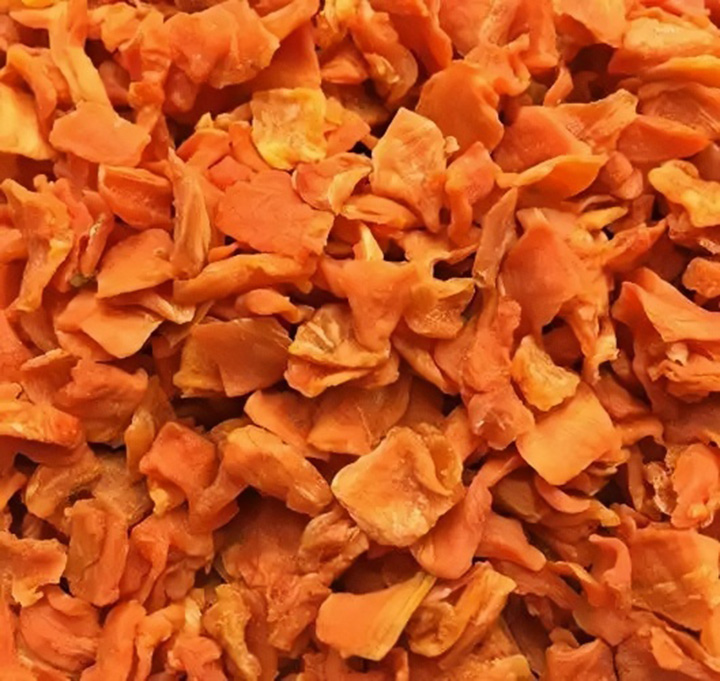
A linear vibrating screen for dried vegetable residue can separate dried vegetable residue into different grades according to particle size, removing impurities such as stones and soil. Dried vegetable residue is the fine residue and fragments left after vegetables have been dehydrated, dried, cut, and processed. For example, in the process of making dried carrot pieces or dried celery segments, vegetable scraps and fibrous residues are produced. Although these dried vegetable residues appear fine, they still contain dietary fiber, trace elements, and minerals, and can be screened and used in animal feed and fertilizer.
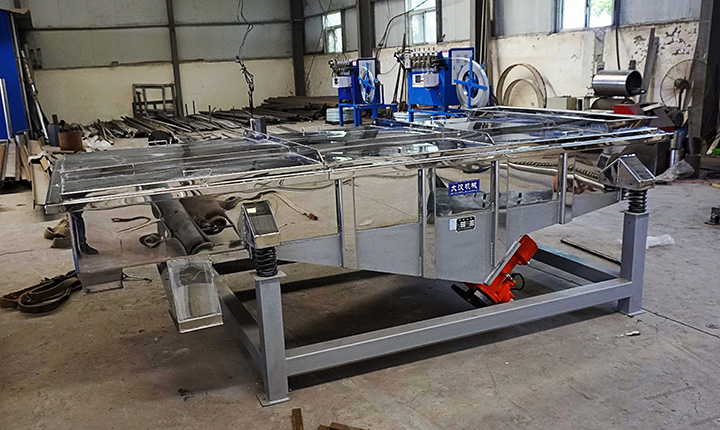
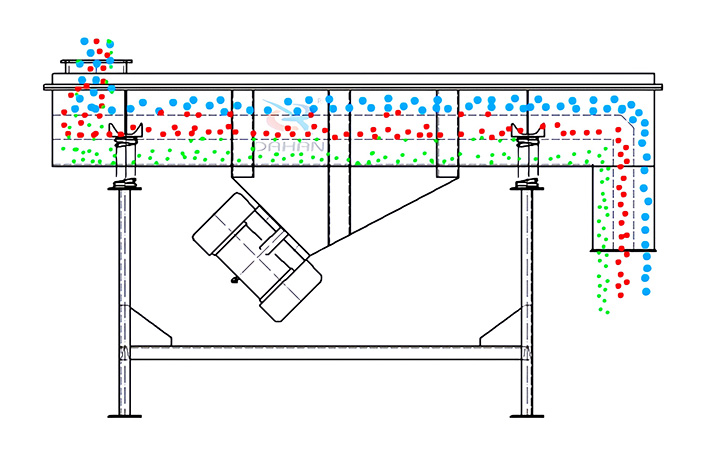
A linear vibrating screen is usually equipped with two vibrating motors. During installation, the axes of the two motors are at a certain angle. When the motors are started, the two motors rotate synchronously in opposite directions, generating horizontal and vertical excitation forces that drive the screen box to perform linear reciprocating motion. After entering the screen, the dried vegetable scraps are subjected to forces in both vertical and horizontal directions. Their movement trajectory on the screen is a straight jump. Dried vegetable scraps smaller than the screen holes pass through the screen and enter the lower screen or are discharged directly. Dried vegetable scraps larger than the screen holes continue to move forward along the screen and are discharged from the discharge port.
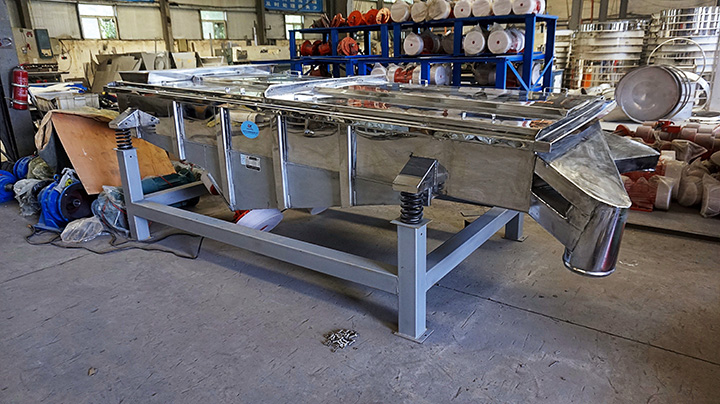
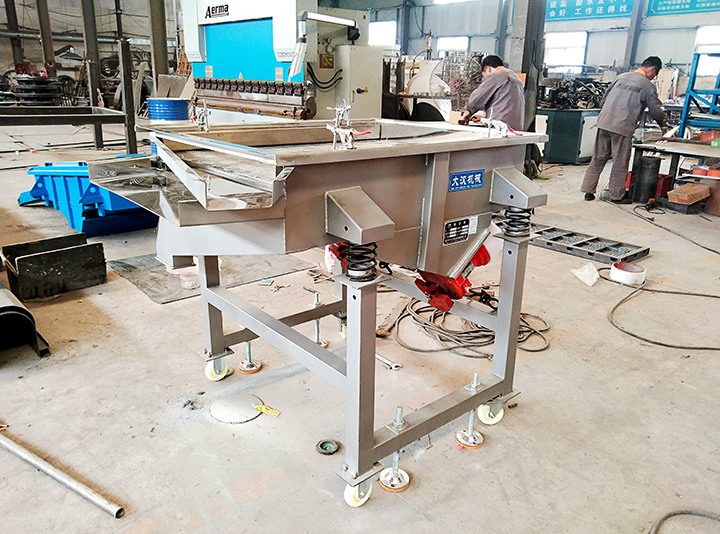
The linear vibrating screen for dried vegetable residue mainly consists of a screen box, screen mesh, vibrating motor, damping springs, inlet and outlet, and base.
The screen box is generally made of 304 stainless steel. If the dried vegetable residue being screened contains pickled vegetables, it can be upgraded to 316 stainless steel, which has better corrosion resistance than 304 stainless steel. The screen mesh can be made of woven stainless steel wire, which is not easily deformed even after long-term screening. A mesh size of up to 200 mesh can be selected. When the dried vegetable residue needs to be separated into multiple particle sizes, 1-5 layers of screen mesh can be stacked for finer grading. Dried vegetable residue may contain dirt and dust; a dust cover can be installed on top of the screen box. The dust cover has an inlet at the top and a dust collection device can be connected to the side, which effectively removes impurities from the dried vegetable residue and prevents dust from flying.
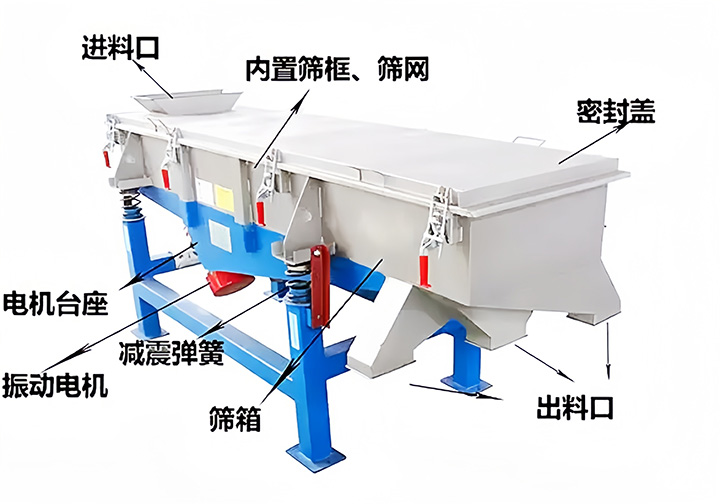
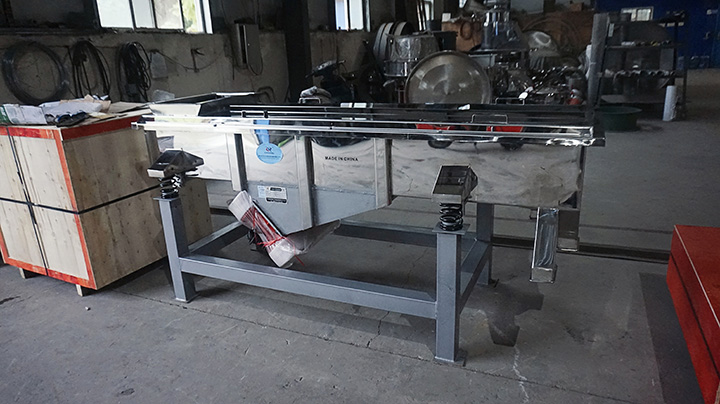
This screen can separate dried vegetable residue into 2-6 grades in a single pass, offering high screening efficiency. Its rectangular screen design allows for screening more residue, resulting in a large processing capacity. The linear screen has a simple structure, requiring only routine maintenance of the screen mesh and vibrating motor, making operation easy. Made of 304 or 316 stainless steel with a polished surface, it is easy to clean and hygienic.
| 型号 | 筛面尺寸 (mm) | 筛面层数 | 网孔尺寸 (目) | 处理量 (t/h) | 振次 (r/min) | 双振幅 (mm) | 电机功率 (kw) | 振动方向角 (°) | 外形尺寸 (长×宽×高) mm |
|---|---|---|---|---|---|---|---|---|---|
| DZSF515 | 500×1500 | 1-5 | 2-200 | 0.12-20 | 960 | 6-8 | 2×0.37 | 45-60 | 2140×808×848 |
| DZSF520 | 500×2000 | 1-5 | 2-200 | 0.12-20 | 960 | 6-8 | 2×0.37 | 45-60 | 2140×808×848 |
| DZSF525 | 500×2500 | 1-5 | 2-200 | 0.12-20 | 960 | 6-8 | 2×0.55 | 45-60 | 2750×808×938 |
| DZSF1020 | 1000×2000 | 1-5 | 2-200 | 0.11-20 | 960 | 6-8 | 2×0.55 | 45-60 | 2219×1320×960 |
| DZSF1025 | 1000×2500 | 1-5 | 2-200 | 0.18-15 | 960 | 6-8 | 2×0.75 | 45-60 | 2269×1320×960 |
| DZSF1030 | 1000×2500 | 1-5 | 2-200 | 0.1-20 | 960 | 6-8 | 2×1.1 | 45-60 | 3219×1340×1120 |
Linear vibrating screen for dried vegetable residue is widely used in food processing dehydrated vegetable production lines, feed processing, pre-composting grading of vegetable waste, and agricultural product processing industries such as carrots and spinach. It is used for screening and removing impurities from dehydrated vegetable residue. It can process dried vegetable residue from radishes and potato roots, dried leafy vegetables such as cabbage and celery, grade dried beans such as green beans and peas, and also process dried vegetable residue from kelp, laver, and shiitake mushrooms. The coarse residue after screening is often used in organic fertilizer and animal roughage filler, while the fine particles are used in high-end organic fertilizer, aquatic feed, and pet food additives.

Add:China, Henan Province, Xinxiang City.Yanjin county forest park gate to the west 1000 meters north road